
St. Tammany Parish Court Records After a Jail Arrest
After an arrest in St. Tammany Parish, the first public record is usually tied to booking at the St. Tammany Parish Correctional Center or a municipal holding point such as Slidell City Jail. The court record begins after prosecutor review. The 22nd Judicial District Attorney, J. Collin Sims, represents the People of the State of Louisiana in prosecutions for St. Tammany and Washington Parishes. According to the District Attorney's public criminal-process explanation, an Assistant District Attorney reviews the facts with police investigators, may speak with a victim, and decides whether the evidence supports a formal case.
This distinction matters because booking charges are not the final court charges. A Sheriff's Office entry may reflect the arresting officer's initial allegation, while the court file tracks the Bill of Information, amended counts, dismissed charges, guilty pleas, trial results, warrants, and sentencing entries. For current custody details, use jail inmate records. For booking-photo questions, use jail mugshots. Court records after a jail arrest should be checked through the Clerk and court search channels, not treated as the same thing as a live roster.
County-specific starting points include the Clerk's case-search notice at sttammanyclerk.org, the Clerk Criminal Department page at sttammanyclerk.org/departments/criminal, the re:SearchLA portal at researchla.tylerhost.net, the STPSO Bond Office page at stpso.com/divisions/bond_office.php, and the DA criminal-process page at collinsimsda.org/criminal/misdemeanor.
Find St. Tammany Parish Court Records
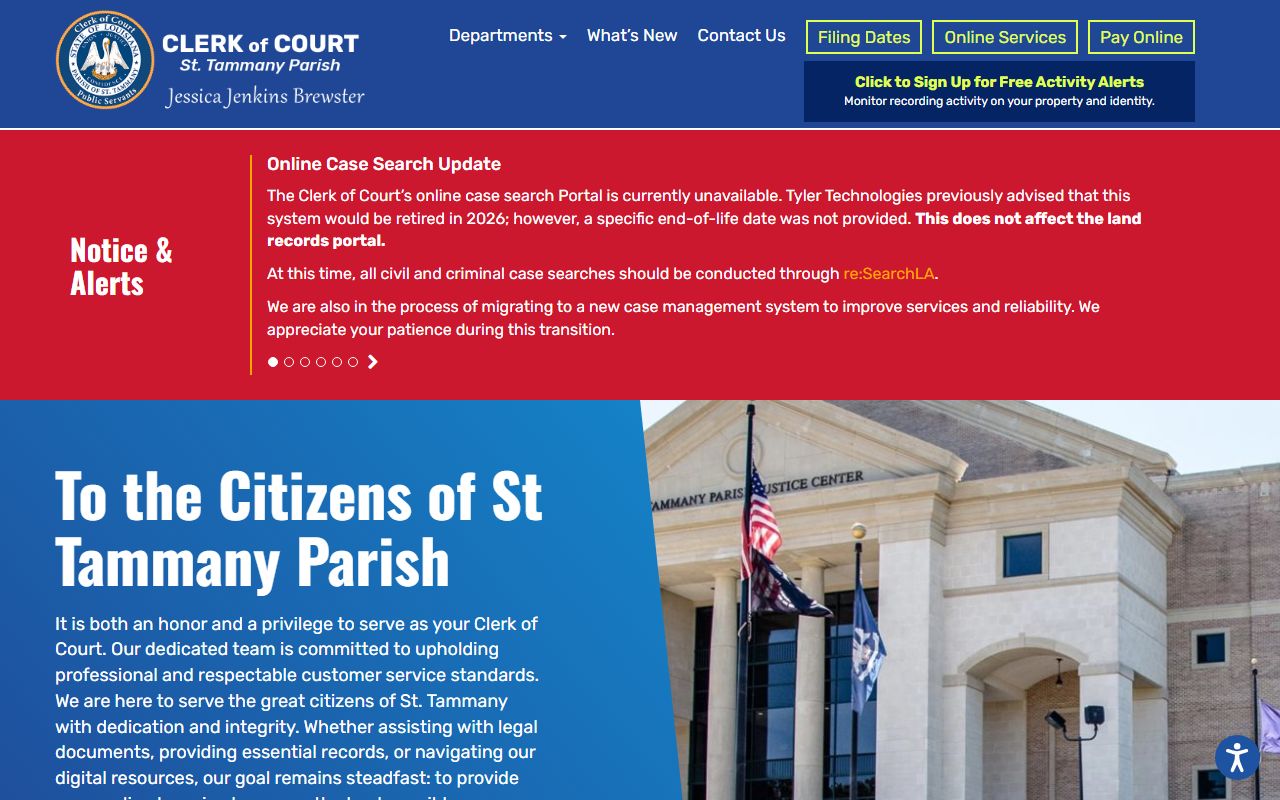
The St. Tammany Parish Clerk of Court says the older online case-search portal is unavailable and expected to be retired in 2026. The Clerk directs civil and criminal searches to re:SearchLA. Criminal case records handled by the Clerk include misdemeanors, felonies, traffic matters, juvenile matters, non-support, criminal defendant histories, background sheets, and appeals, but sealed cases and sealed documents are not available to the public.
- Open the Clerk's current court-search route through the St. Tammany Parish Clerk or go directly to re:SearchLA.
- Search by the defendant's name or a known case number. If the arrest was recent, allow time for prosecutor review and filing.
- Open the criminal case result and compare the charge list against any booking charge shown by STPSO.
- Check each count for filing type, amended language, disposition, sentence, warrant activity, and current status.
Because the re:SearchLA portal is JavaScript-heavy, the research capture did not expose a full field inventory. The Clerk's public notice is still important: St. Tammany users should not rely on the retired local portal for current civil or criminal searches. If a name or docket search returns no match and the matter may be sealed, the Clerk says users should contact the Clerk at (985) 809-8700. Subject to law and court orders, some sealed-record handling may require in-person access at the Covington office.
| re:SearchLA Field | Type | Required | Local Note |
|---|---|---|---|
| CourtRecordsSearch Home | Web portal | Unspecified | Used for Louisiana court case information, including St. Tammany records through the Clerk link. |
| Defendant name or case number | Search term | Unspecified | Exact field labels were not exposed in fetched text; use the live portal prompts. |
| Sealed matters | Restricted access | N/A | Sealed cases may return no match online and require Clerk contact or lawful in-person handling. |
The Clerk homepage shows the court-search transition to re:SearchLA.
Complaint, Information, Indictment
The post-arrest court pathway usually runs from arrest and booking to bond or a 72-hour hearing, then to prosecutor review and a formal charge document in the 22nd Judicial District Court or the relevant city court. The DA page explains that an ADA may decide the evidence supports the police charge, may select different final charges, or may refuse prosecution if the evidence is not enough or more investigation is needed. In Louisiana practice, the Bill of Information is especially important for many prosecutions because it is the prosecutor's official charge list.
| Complaint | Bill of Information | Indictment | |
|---|---|---|---|
| Filed By | Officer or prosecutor, depending on court and charge | District Attorney through a prosecutor | Grand jury |
| Common For | Initial misdemeanor or municipal allegations | Many Louisiana felony and misdemeanor prosecutions | Serious felony matters requiring grand-jury action |
| Record Effect | Starts or supports the case file | Sets the formal prosecutor-filed charge list | Creates a grand-jury charge document |
The DA criminal page explains the local review, Bill of Information, refusal, arraignment, and warrant process.

Charge Status and What It Means
Charge status can change several times between the jail arrest and final court result. The roster may show an arrest charge. The court record may later show a refused count, an amended count, a reduced charge, a dismissed count, a guilty plea, or a trial verdict. Always read each count separately. A person can have one dismissed charge and another charge still pending in the same case.
| Status | What It Means |
|---|---|
| Pending | The charge is open and has not reached a final court disposition. |
| Amended / Reduced | The prosecutor or court record changed the original count, often to a different grade or offense. |
| Dismissed | The court record shows the count is no longer being pursued in that case. |
| Refused / Declined | The DA did not issue a formal prosecution on that allegation after review. |
| Nolle Prosequi | The prosecutor formally chose not to continue the charge. |
| Convicted / Guilty Plea | The case reached a conviction by plea or verdict, which is different from merely being charged. |
Bond and 72-Hour Hearings
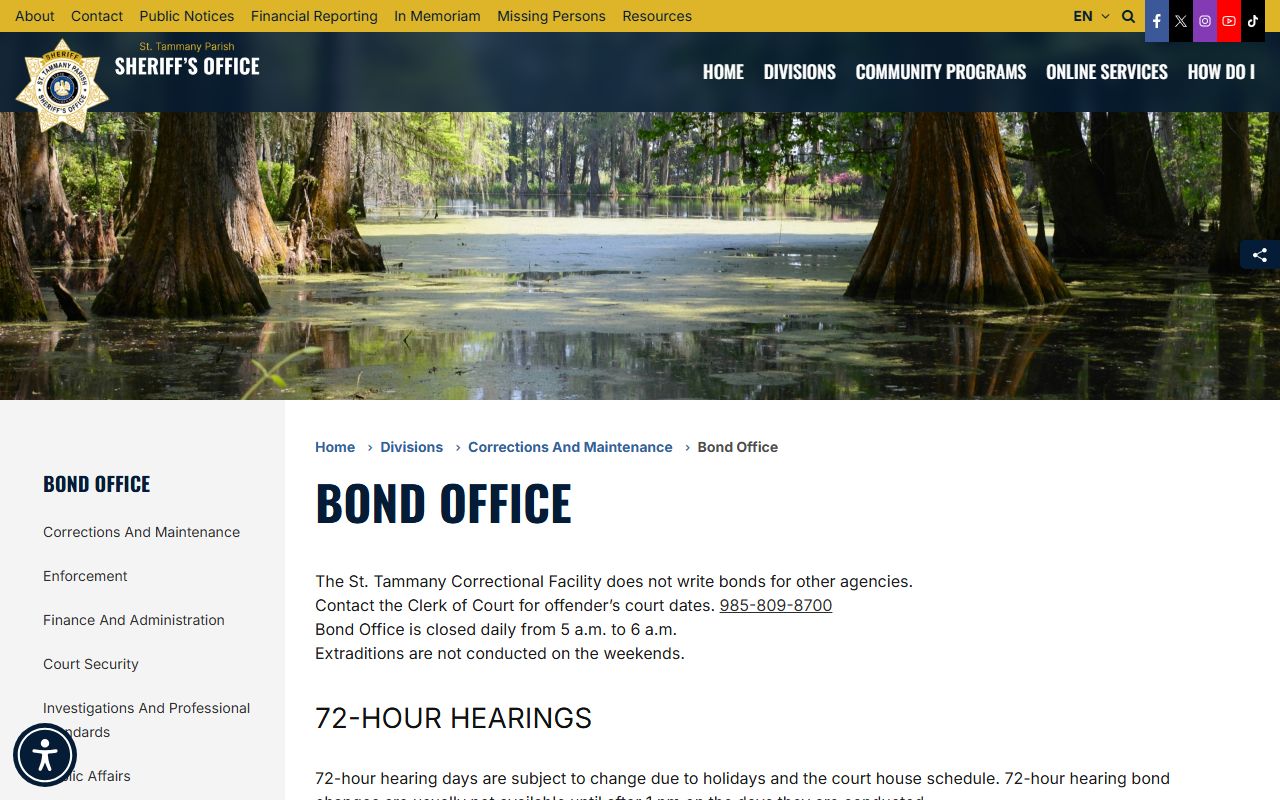
STPSO Bond Office information is separate from the Clerk's court-record search, but bond activity affects the court timeline. STPSO notes that 72-hour hearing days can change because of holidays and courthouse schedules, and bond changes from those hearings are usually not available until after 1 p.m. on hearing days. The St. Tammany Correctional Facility does not write bonds for other agencies, and STPSO directs court-date questions to the Clerk of Court at (985) 809-8700.
| Bond Type or Item | How It Works Locally |
|---|---|
| Cash Bond | Requires the full bond amount plus a $30 bond fee. Cash payments require exact change. |
| Surety Bond | Uses a bondsman. STPSO says bondsmen usually charge 10% to 14% of the bond amount, while its fee list also includes a bondsman 2% item. |
| Personal Surety / Signature Bond | Requires a valid Louisiana driver's license and $30 cash when eligible. LA Wallet is not accepted as identification. |
| Property Bond | Requires sufficient clear equity plus the local bond fee. |
| Court Cost Attachment | STPSO lists a $268 court cost attachment that must be paid in full. |
| No-Bond Hold or Detainer | A hold by another agency or legal authority may prevent release even if local bond is otherwise addressed. |
The STPSO Bond Office page is the local source for 72-hour hearing timing, bond fees, release-date limits, and payment rules.
Clerk Criminal Records and Fee Details
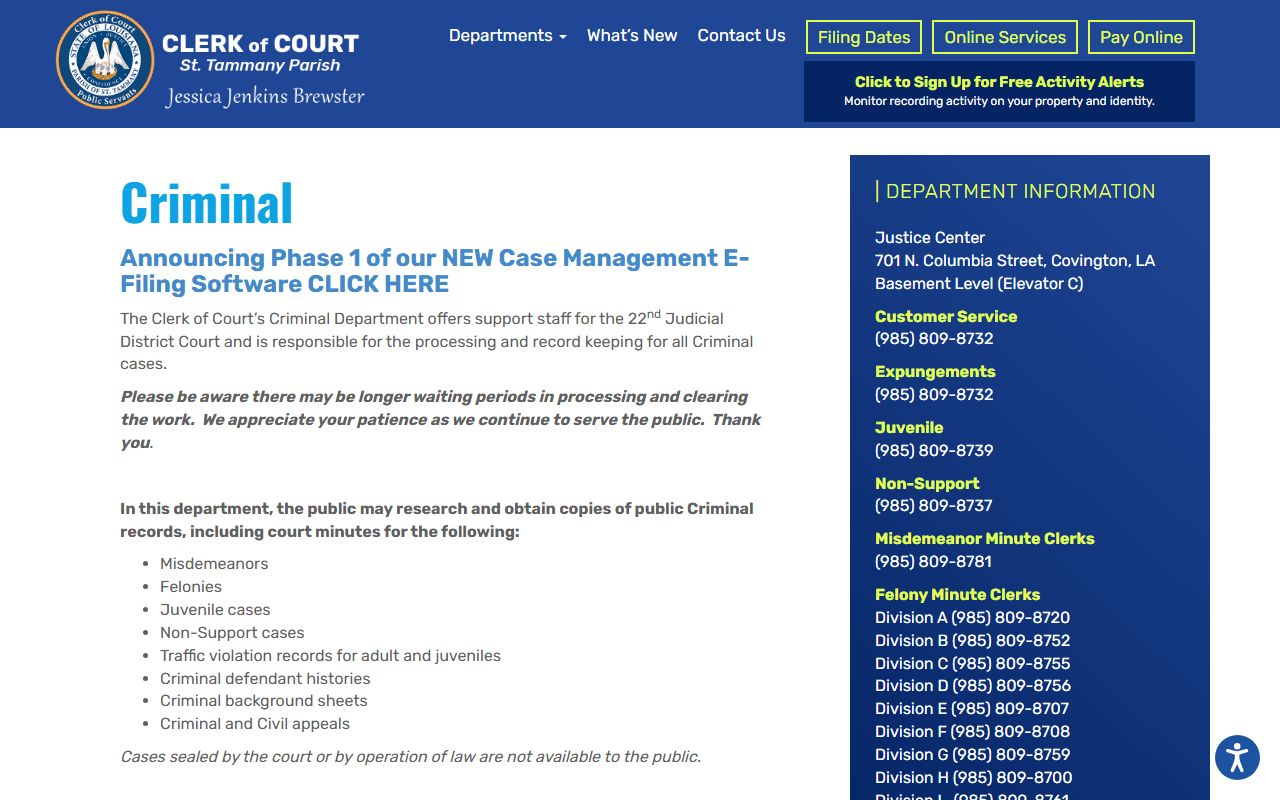
The Clerk Criminal Department is located on the basement level of the St. Tammany Parish Justice Center and lists weekday hours of 8:30 a.m. to 4:30 p.m. Its criminal department phone is (985) 809-8732. The Clerk page also warns that cases sealed by court or by operation of law are not available to the public. That limitation applies even when a person knows an arrest happened.
| Criminal Clerk Item | Fee or Rule |
|---|---|
| Criminal background search per name with certification | $20 |
| Defendant history report | $1 per page |
| Certified extract of court minutes | $10 |
| Copy fee | $1 per page |
| Conformed copy of pleadings filed | $3 |
| Certified copy of document | $10 |
| Outgoing fax | $5 first page, $1 each additional page |
| Fax filing | Not available for criminal, traffic, and support enforcement |
The Clerk Criminal Department page lists criminal records, sealed-record limits, expungement links, and fee materials.
Warrants and Failure to Appear After an Arrest
STPSO Criminal Records says the division houses all warrants issued by the 22nd Judicial District Court through the agency. No official public active-warrant search field was located in the research, so warrant questions should go to Criminal Records at (985) 809-8242, the STPSO public-records request portal where appropriate, and the Clerk or re:SearchLA for related court-case history. Sheriff Randy Smith is the elected sheriff listed by STPSO, and STPSO operates the local jail and records channels used for arrest and warrant routing.
An arrest warrant, bench warrant, attachment, or failure-to-appear warrant can all lead to booking at the parish jail. The DA page states that failure to appear at arraignment or trial can result in a bench warrant, and court-mandatory traffic violations may lead to a warrant if the person fails to pay or appear. Search warrants are different; they authorize a search and do not by themselves create an inmate lookup issue.
Charges vs. Convictions
A charge is an accusation. A conviction is a result. St. Tammany Parish court records after a jail arrest may show charges before any plea, trial, or final disposition exists. Do not treat a filed charge, booking charge, or warrant entry as proof that a person was convicted.
| Charge | Conviction | |
|---|---|---|
| Stage | Accusation filed or alleged after arrest | Final result by guilty plea, verdict, or qualifying adjudication |
| Proof Level | Based on probable cause or prosecutor assessment | Requires proof beyond a reasonable doubt or a valid plea |
| Record Meaning | Shows what was alleged or filed | Shows the person was legally found or admitted guilty |
| Practical Caution | May later be amended, refused, or dismissed | May affect sentencing, criminal history, and eligibility rules |
Sealed vs. Expunged Records
Louisiana public-record law supports access to many booking and court records, but access is not unlimited. Louisiana R.S. 44:1 defines public records and public bodies. Louisiana C.Cr.P. art. 228 says booking books and booking information summaries at jails and police stations are open for public inspection. Louisiana C.Cr.P. art. 973 and the Louisiana State Police expungement process address court-ordered expungements that remove criminal arrest or conviction records from public access except as law allows.
| Sealed | Expunged | |
|---|---|---|
| Public Visibility | Not available to the public because of court order or law | Removed from public access after an eligible court-ordered process |
| Online Search | May return no match in re:SearchLA | Should not appear as an ordinary public criminal-history record after processing |
| Who May Still See It | Access depends on the order, statute, agency role, and in-person Clerk handling | Louisiana law preserves limited access for specified agencies and purposes |
| Where to Start | Contact the Clerk if a known case may be sealed | Use court expungement forms and Louisiana State Police expungement guidance |
Background Check Considerations
Casual court lookup is not the same as a legally compliant employment, tenant, credit, insurance, or licensing background check. Public court records can be incomplete, restricted, recently changed, or misread without the complete docket and disposition. Louisiana expungement, sealed-record rules, and Clerk access limits also affect what a public search may show.
Important: This private site is not a consumer reporting agency and must not be used for FCRA-covered screening decisions.
Restricted St. Tammany Court Records
Some records connected to an arrest are not ordinary public lookup material. Juvenile matters, sealed cases, certain documents restricted by court order, and records withheld by operation of law may not appear in public court search results. The Florida Parishes Juvenile Detention Center serves the 21st and 22nd Judicial Districts, including St. Tammany Parish, but juvenile custody records should not be treated like adult jail-roster records. Ongoing investigations can also limit what is released through law-enforcement records channels.
For a current adult jail booking, start with STPSO custody channels. For court records after a jail arrest, use the Clerk's re:SearchLA route and the Criminal Department. For warrants, use STPSO Criminal Records or the Clerk's court record. Those systems overlap, but they do not publish the same record at the same time.